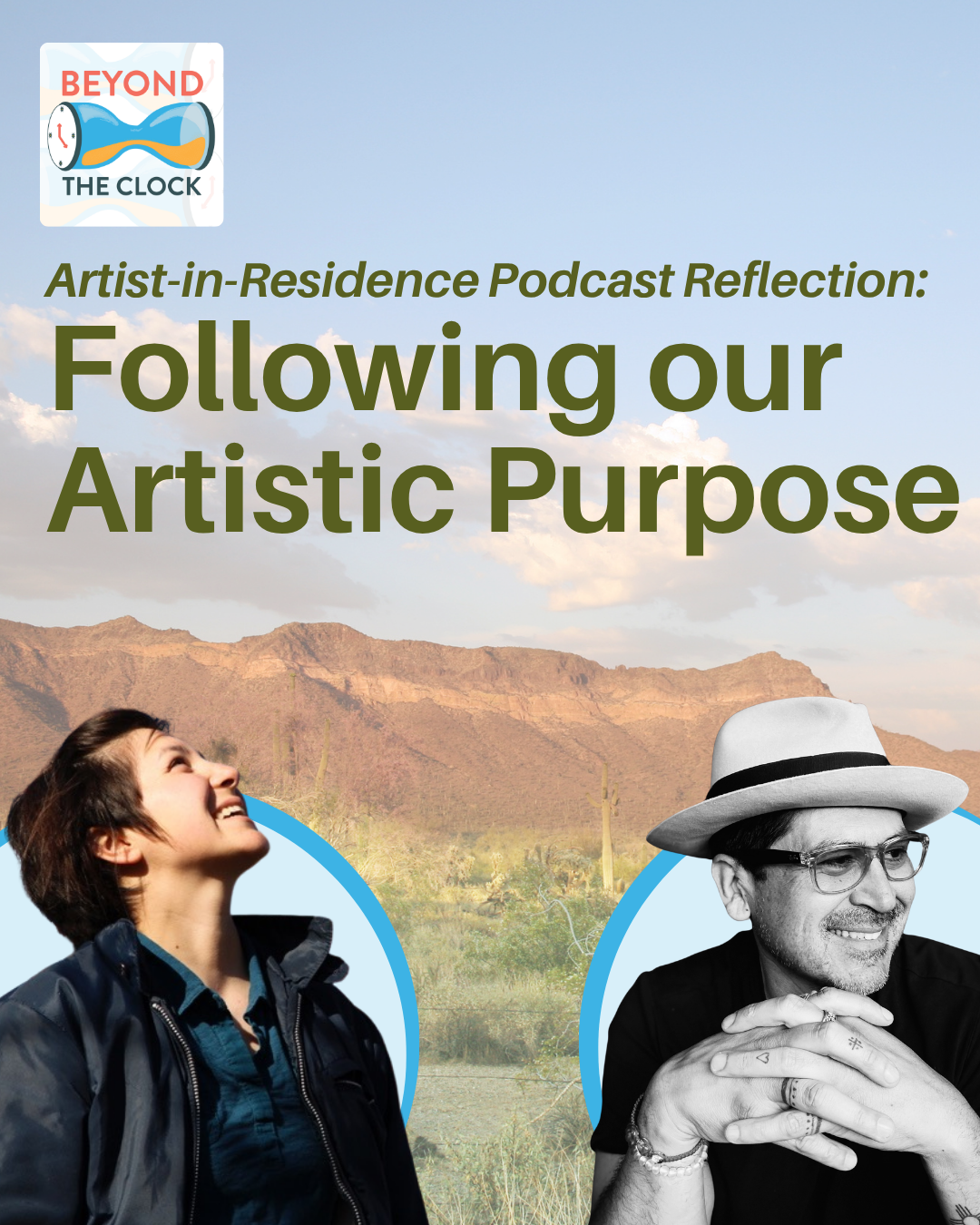
Beyond the Clock Artist-in-Residence Podcast Reflection: Tim Z. Hernandez | Following our Artistic Purpose
By the 2026 Beyond the Clock Artist-in-Residence, Nikiko Masumoto
It is hard for me to contain my joy and the soft swelling of both pride and honor in knowing Tim Z. Hernandez. I have already listened to the latest Beyond the Clock podcast with Tim multiple times – each time, something new is illuminated and delicious to hear, like wisdom being offered in the flavors of the season at my favorite ice cream or paleta shop, just the thing I was waiting for to refresh my creativity and determination.
As your artist-in-residence, I was reflecting on how to articulate why exactly do I feel all these amazing things when I get to encounter any of Tim’s work? There are the obvious and personal connections: we grew up in shared contexts of the seasons of California’s Central Valley – the rhythms of childhood was woven with the harvests of our region, backroads and long rows of trees or vines, the dust, our immigrant families working and hustling, stories of place, longing, and ancestors. I imagine many of the themes of Tim’s work resonate in many rural contexts across our country.
But there’s something deeper that I feel drawn to – beyond the things we share (which are profound and beautiful) – I feel propelled forward to create by both who Tim is and what he shares about his creative practice. He offers a model of being an artist in the world as a way of being. There is a moment that stood out to me in the podcast where he reflects on what art is, Tim says:
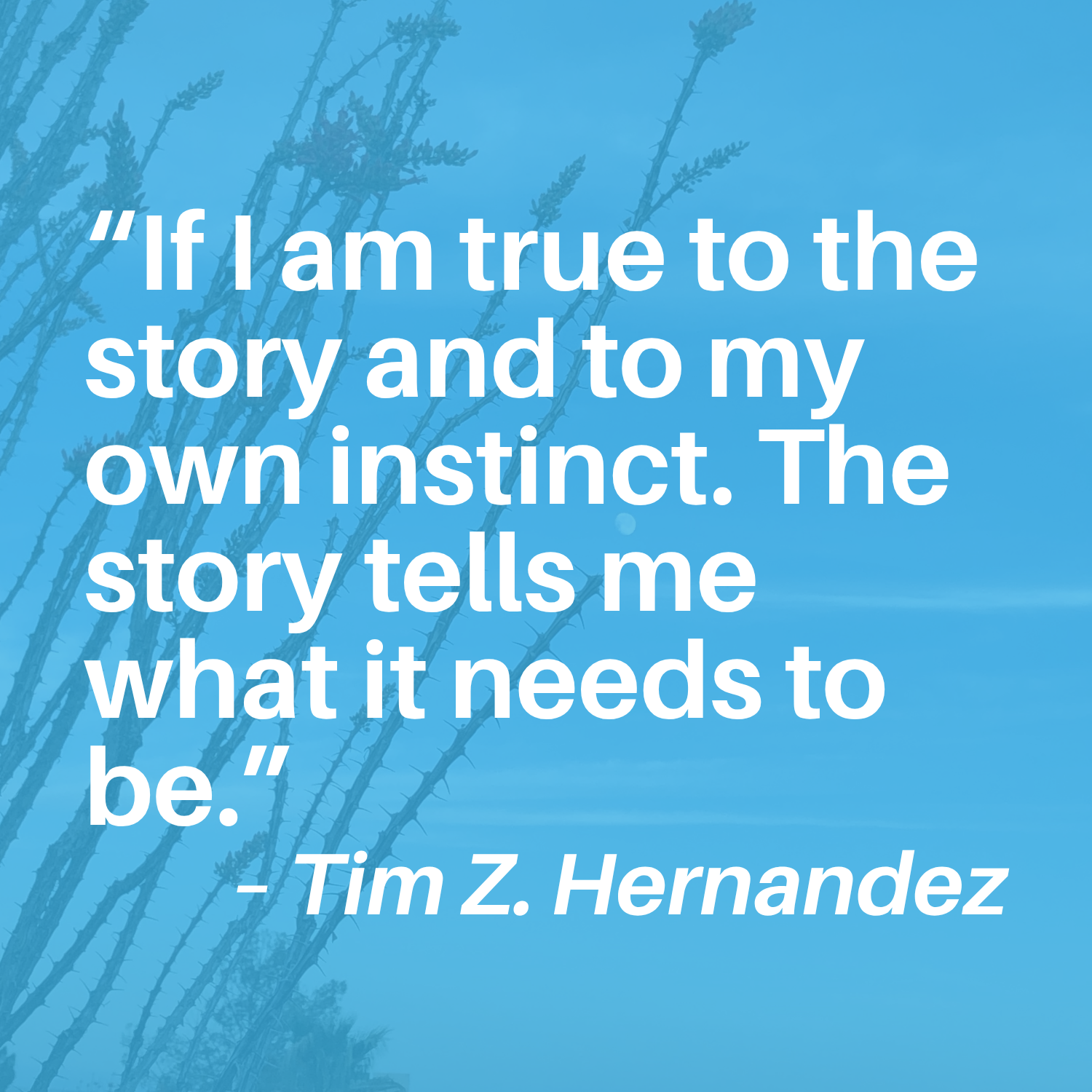
“Art to me is an offering. I can’t think of art when I make it as commodification. I can’t think of art when I make it as a product. [...] There was once upon a time early in my career when I was kind of striving for that [...] in some way. Through time and experience in life, I started to recognize that that was a lot of tension to place on myself and expectation to place on the art. Because at the end of the day, you have no control over how art is received. You have no control over who decides if they want it or need it and who doesn’t. So the best thing I could do is come to a place in myself organically, where I say, you know what, why am I doing this? What is the purpose here? I’ve come up with a few reasons why I make art or writing [...] they always seem to fall into these few reasons. One is, I make art or writing to let go of something. I’ll write things down and then I don’t have to carry it with me anymore. That’s one purpose. Another one is, I make art to retain, to keep memory as you pointed out. I make art to document; I make art to memorialize to say “We exist and we cannot unexist!” And then I think the third reason why I make art is to heal. I make art because it is very cathartic for myself and hopefully and by extension for anyone else.”
What I love and appreciate so deeply about Tim’s reflections here is the trust he places in himself as an artist.
What I hear in his reflection is a beautiful path of creativity that folds in permission and clarity: he grants himself full whole-hearted permission to create (not tethered to “how art is received”) and also stemming from that same permission is a path of humility.
He is not creating a piece of art for the sake of the ‘piece’ - he’s creating art for deep sacred purposes: release, memory keeping, healing. And in that path of both abundant and brave permission to explore and create, he’s also intentionally articulating a purpose his art serves for him, and the offering extended to anyone for whom it might also serve. He is listening for how the work calls to him in deeper and how others connect to it.
I am so grateful for Tim and this model of creativity. When I come up against my own doubt (do I have the right to tell this/that story? Is my voice needed? Am I a good enough writer or storyteller? Is someone better suited to create the thing in my imagination?), what Tim offers is a different portal through. Instead of questioning if I have the right to tell a story (or make a painting, or a film, or etc.), I hear Tim reframing: what happens when I open my creative powers to the story (or project)? What does the story ask me or call me to do next? How can I show up with humility and give my time, energy, and talents as an offering? What profound keys to unlock streams and rivers of creativity! Thank you, Tim!
In my life as a farmer, I don’t have as much time to dedicate to the craft of creating art during the summer as I do in other seasons. (I’m curious if other rural folks have seasonal flows to your creative practices?) My days are full of sweat and harvesting peaches, nectarines and apricots.
And yet, there’s something porous and linked between my vocation of farming and my life purpose as a memory keeper and artist. I know there’s something here, rich in connection and stories. Over the past few years, I started thinking of a big contribution: what is my artistic addition to the story of our farm and place? I’ve been mulling over if it’s a writing project, or a project of immersive gathering, or a project of traveling stories or a listening laboratory. I’m not sure.
As a multi-talented artist, Tim shares in the podcast about the early beginnings of the project at the heart of two books (All They Call Will You and They Call You Back) as well as countless arts and healing gatherings, music, and forthcoming film. All of these creations stem from a quest to try to understand the story of the people and impact behind a plane crash in 1948 that killed farm workers, Mexican citizens being deported as well as the pilot and crew of the plane. One crash: so much erasure, unhealed grief, and negligence by the California and federal government. (The next offering of this project is a film. The few minute excerpt gives me goose-bumps every time I watch it. I don’t feel like an observer, I feel like a witness to layers of inter-generational healing. I highly recommend following (and supporting!) this film project!)
Tim is an incredible individual who is a dynamic artist – able to work in many mediums from painting to theater to poetry and prose. In conversation with Ash and Anna, he shares that at the beginning of trying to understand the plane crash story, he wasn’t sure what the project would be. In this episode he shares his own questioning: is this a painting? Is it writing (as he’s journaling)? Instead of feeling pressure to know definitively, Tim followed the next creative calling, from painting, to journaling, to connecting a family of someone who perished in the plane crash. He didn’t encumber himself or the creative process by declaring what the artistic “product” was to be – instead, he kept listening and embracing the possibility of maybe. Maybe this is many many things.
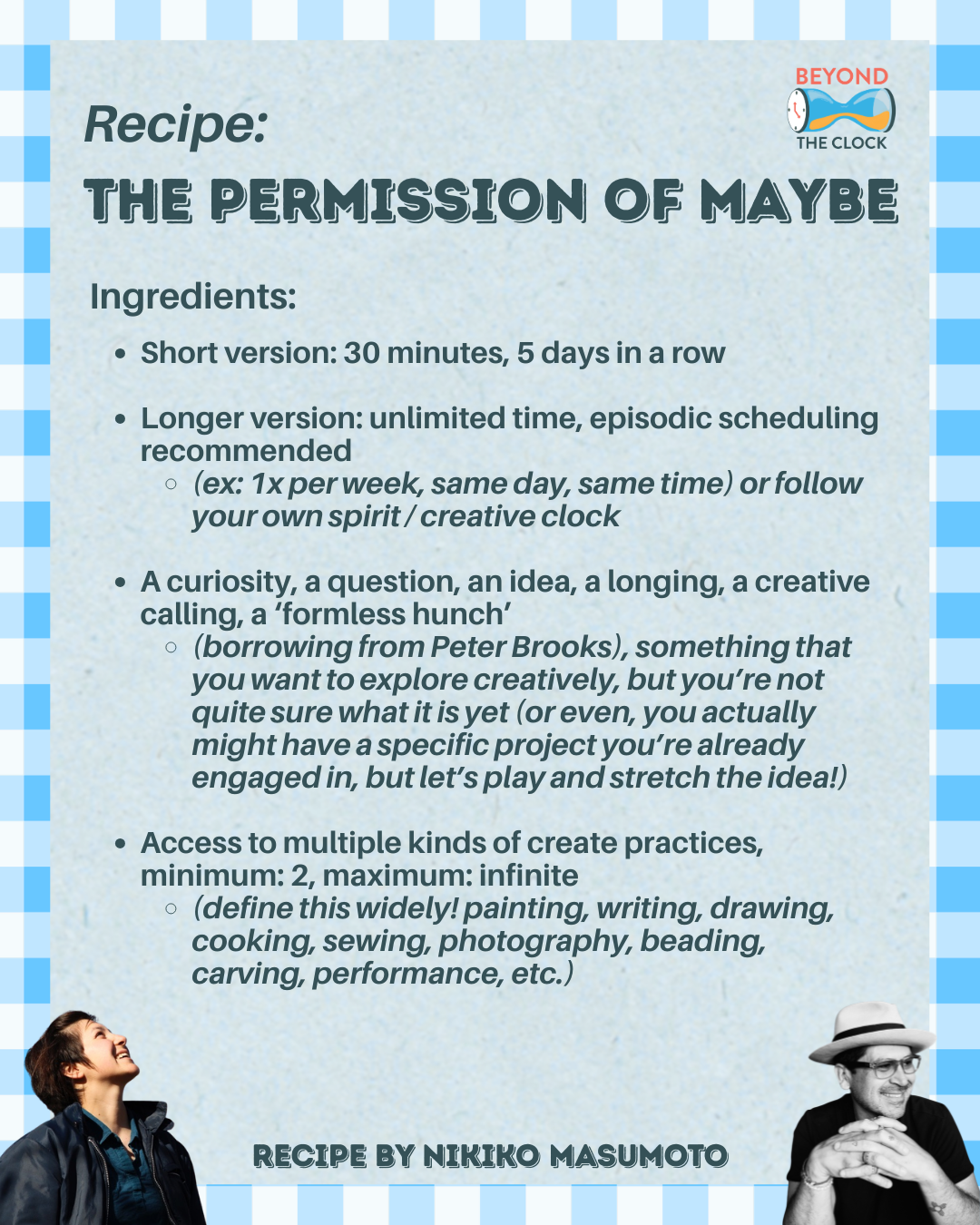
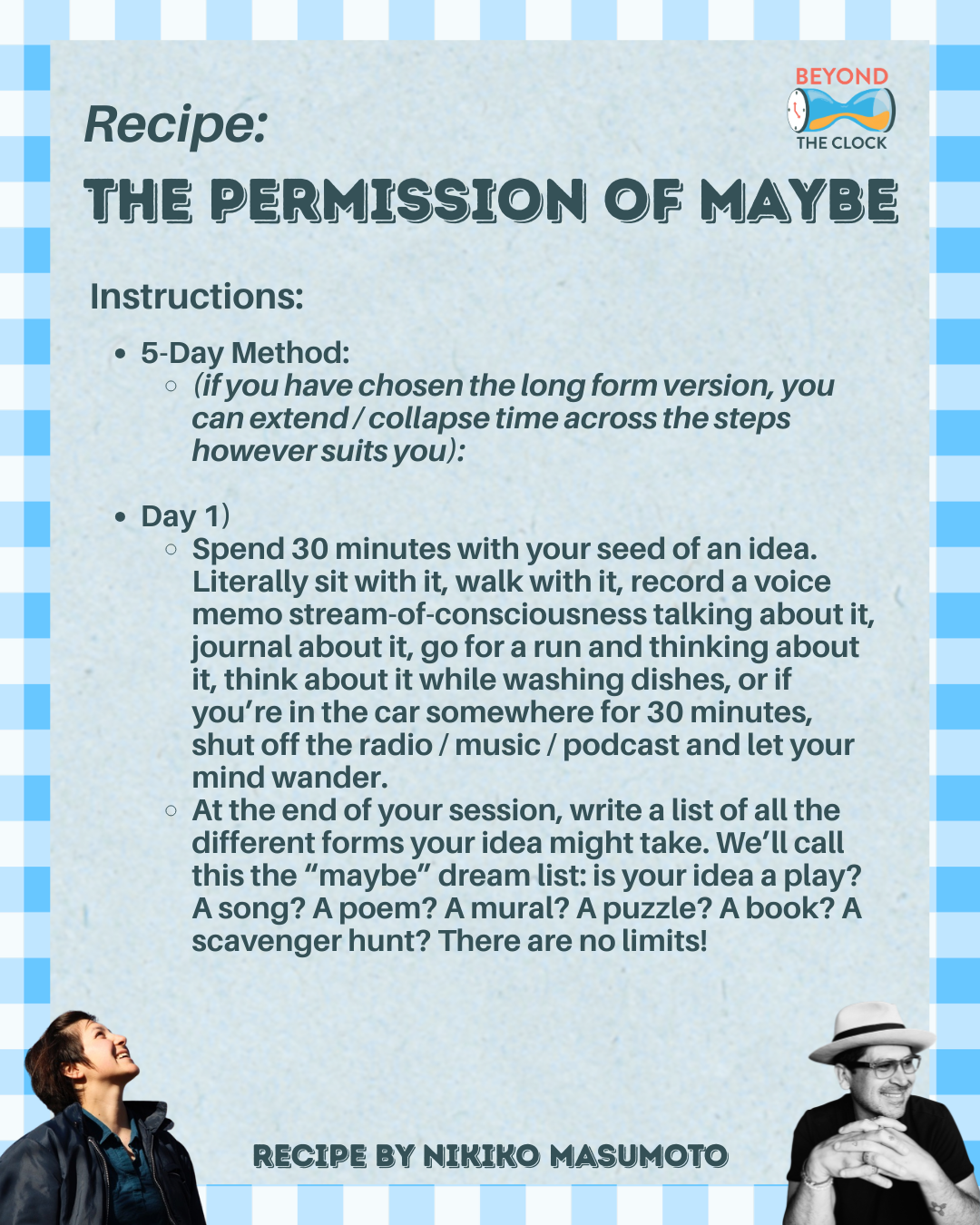
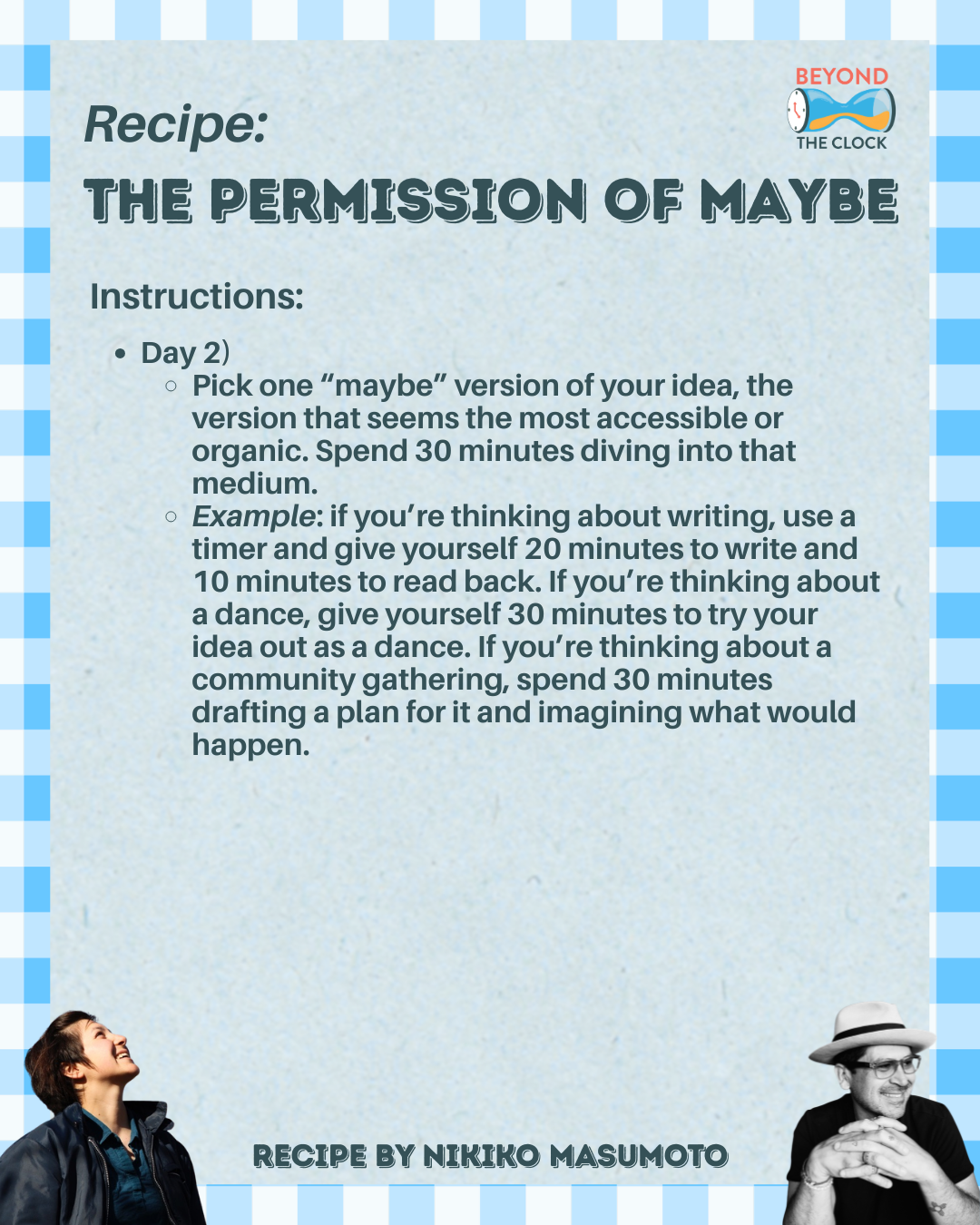
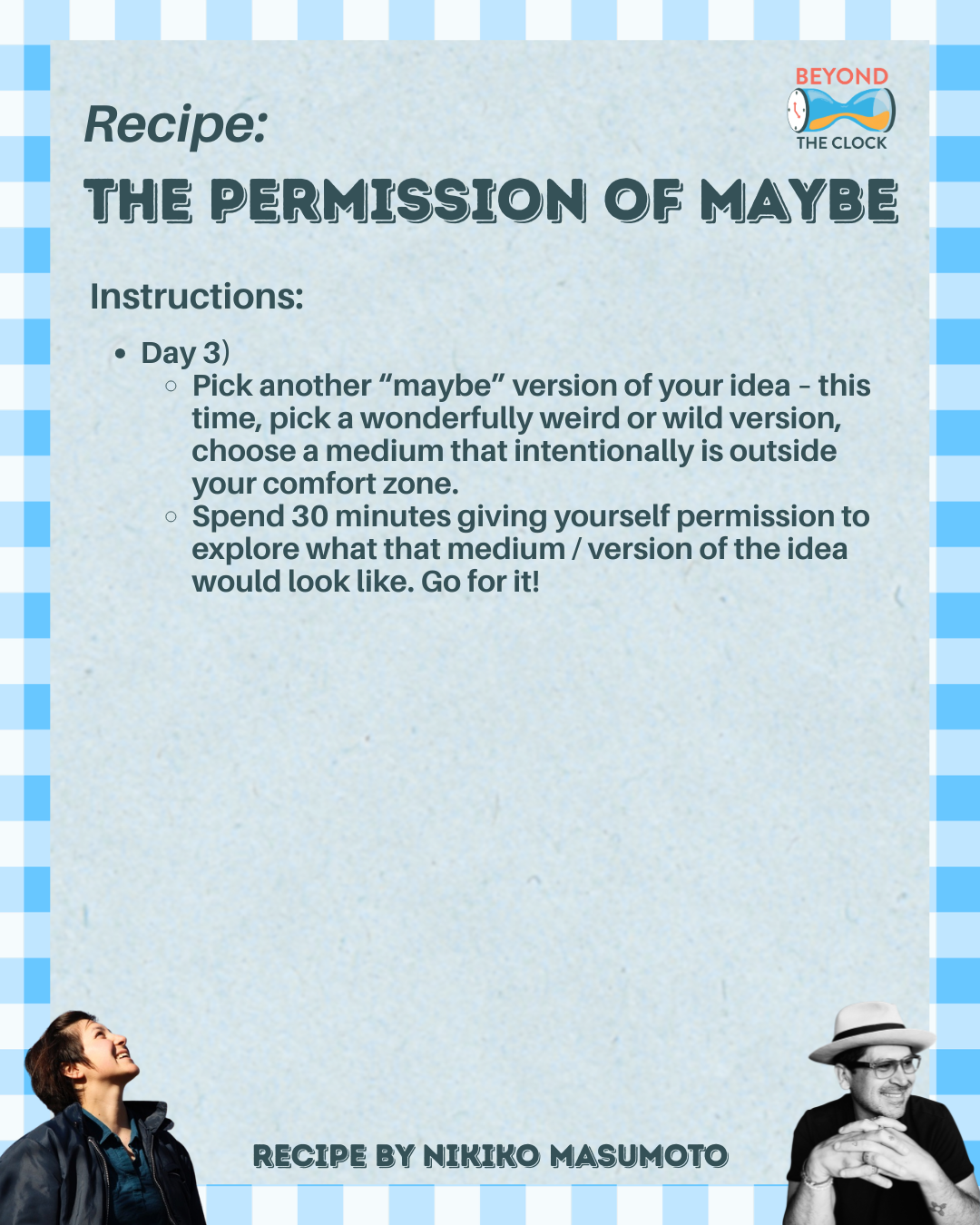
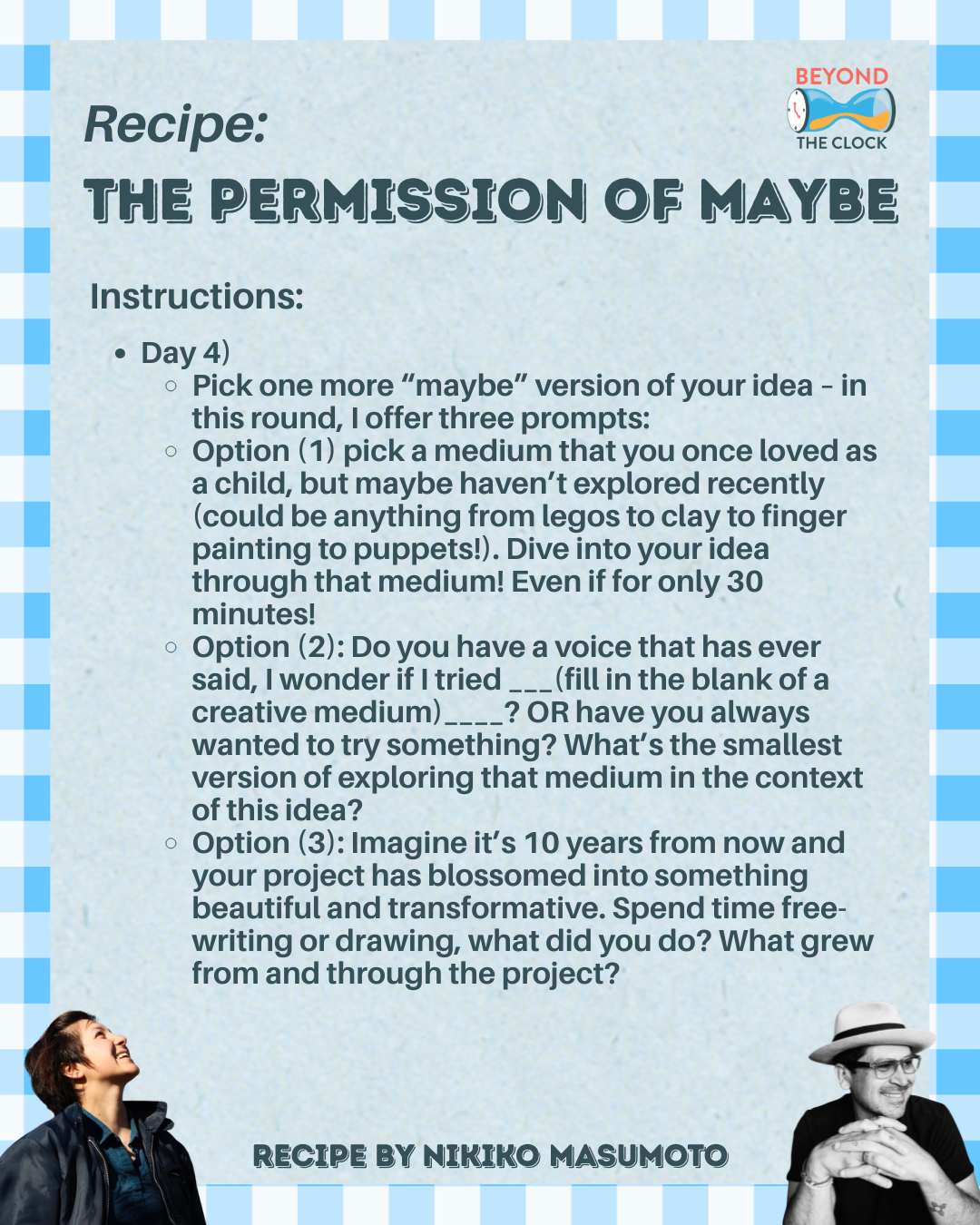
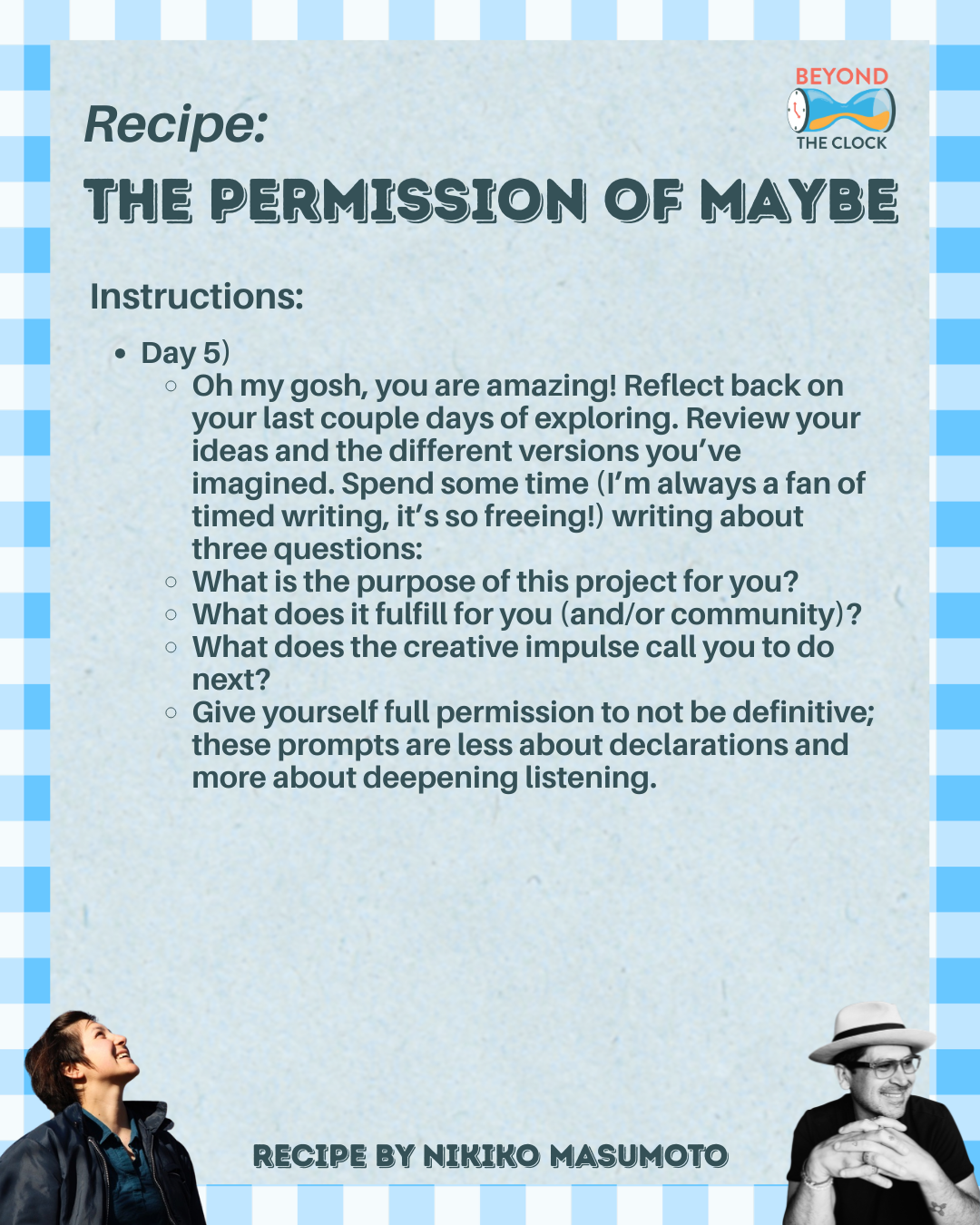
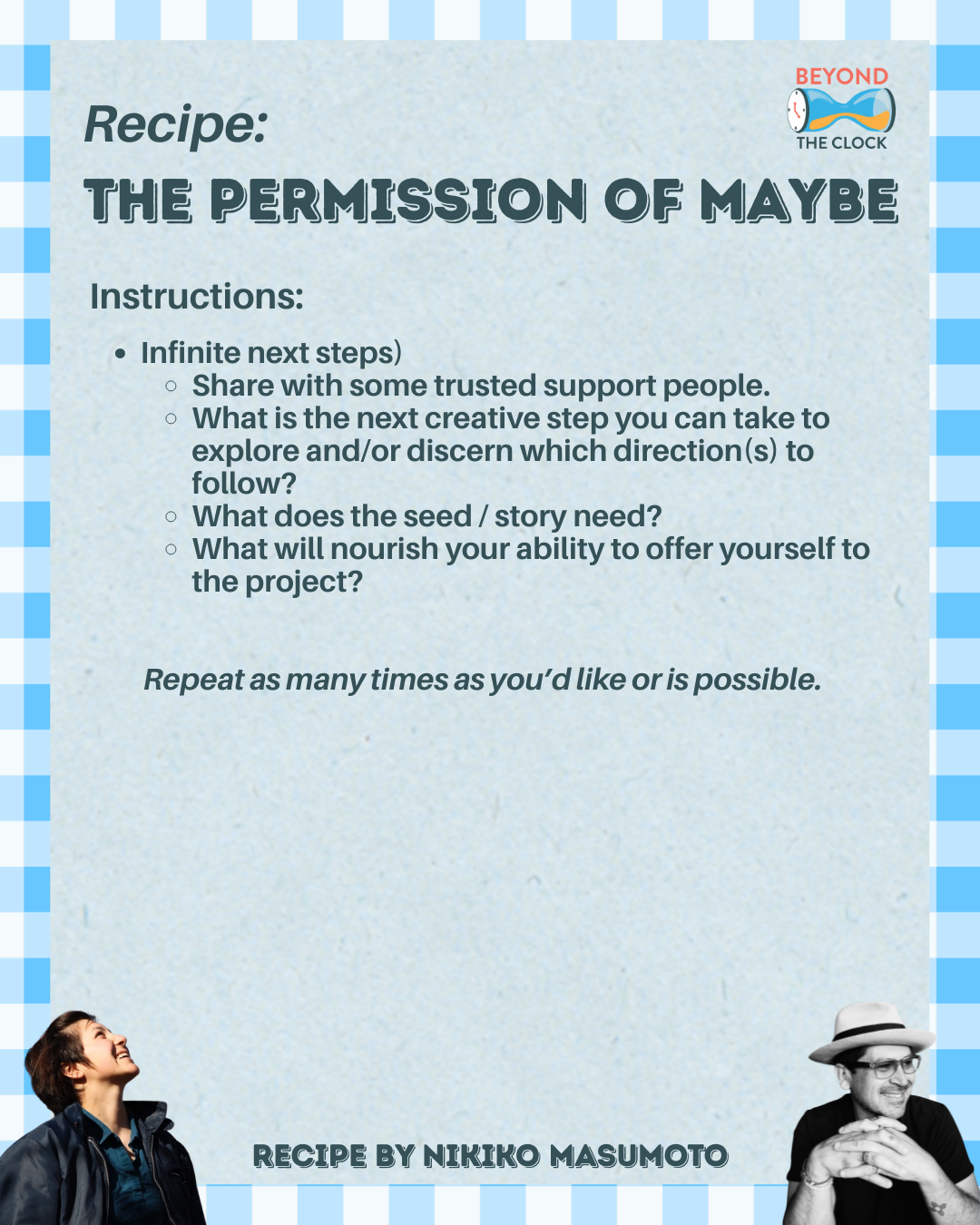
The recipe I’ve developed from Tim Z. Hernandez’s incredible wisdom is one that can help with the generative “I’m not sure” part of creativity. It invites us to see unknowing not as a deficit, but instead as fertile ground for creative energy and curiosity to propel and call us forward.
It is a gift to interact with Tim as a listener, a reader, an audience member, as a neighbor and friend. I am so thankful for Tim and the magical learning exchange Beyond the Clock creates for us all!
About the 2026 Beyond the Clock Artist-in-Residence: Nikiko Masumoto
Nikiko Masumoto is an organic farmer and artist. She is Yonsei, fourth-generation Japanese American, and stewards the same soil her great-grandparents worked in California where Masumoto Family Farm grows organic fruit. She’s co-written several books, including most recently a children’s book, Every Peach is a Story, with her father David Mas Masumoto. Nikiko is an arts-leader and co-founder of Yonsei Memory Project, an arts-based initiative to activate Japanese American history in the Central Valley. She served on USDA’s State Committee, and volunteers on various non-profit boards. Her most cherished value is courage and most important practice is listening.