Reflecting on the Offerings in the latest Beyond the Clock Podcast: with Allie Redhorse Young | By the 2026 Beyond the Clock Artist-in-Residence, Nikiko Masumoto
I can’t stop thinking about the most recent Beyond the Clock podcast with Allie Redhorse Young.
Gratitude doesn’t feel like an adequate word to express a reciprocity toward Ms. Redhorse Young for sharing so much depth in this conversation with Ash and Anna. For me, this episode is like a well, one that I can listen to over and again to draw water to quench moments of parched spirit. There is so much she offers to us in this episode - examples of centering care for Native elders and youth, re-imagining civic action within profound ancestral practices, and living out values of belonging. Thinking about this episode as ‘a well’ also asks different questions of me as a listener. Wells risk running dry too if we do not pay attention, tend and offer care. I remain steeped in questions of how I/we can nourish this well: what is my relationship to youth, Native communities, and civic practice? How am I showing up? What ancestral ways am I connected to or can I call upon? I want to talk through this work slowly, and for a long time. Today, I share circles of thoughts that keep re-energizing me.
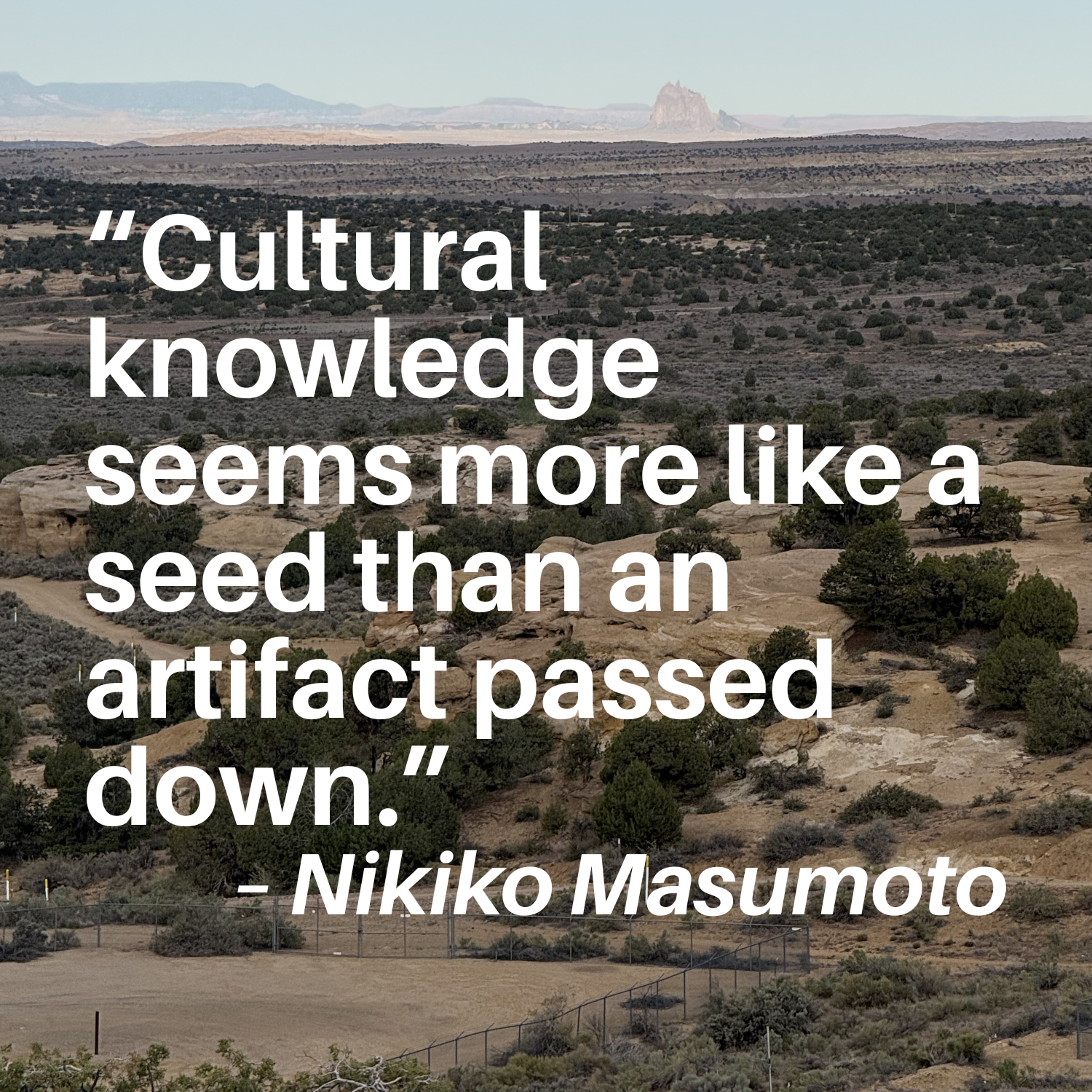
Allie Redhorse Young describes the purpose and genesis of her work through the organization she founded, Protect the Sacred. In contrast to property-centric ways of thinking, “the sacred” is not an object or thing. I understand Allie to be describing “the sacred” as the flow of ancestral and cultural knowledge both from elders towards the wider community and also from / through youth as future ancestors. This is profound framing to me. Cultural knowledge seems more like a seed than an artifact passed down. Seeds are planted, cared for, harvested, saved and passed along through generations, and each generation contributes their attention and tending. In the process, change and adaptation are not in opposition to continuation, as seeds, plants, and their caretakers can adjust to conditions for survival and flourishing.
Ms. Redhorse Young’s dedication to youth makes me reflect on the ways my community work does or does not include, welcome, and take seriously youth as culture bearers. In the live Beyond the Clock session, Ms. Redhorse Young shared how during the pandemic, she received candid messages from youth questioning the power and relevance of voting. I was deeply struck by her response. I would not have had the foresight to engage the way she did. She expressed how earnestly she listened to the youth – not dismissing them and their concerns because their lived / generational experience was different. Instead, she engaged with their thoughts and created an offering for not only youth, but also the wider Navajo community: a program called “Ride to the Polls.” Listen to the podcast for a fuller and deeper sharing of this incredible program!
Also in this episode, Ms. Redhorse Young generously shares a Navajo philosophy of belonging : everyone is to be treated as family and belonging to one another. In other words, someone else’s child is as important as your child. I hear this as a call to embrace all people as part of your/our relations. This opens up interesting pathways of behavior for me as I think about youth as my imagined extended family. Their concerns then, don’t feel far away, they feel relevant to the health and wellness of our wholeness, of our community.
This is particularly resonant to me in my Japanese American community. We often organize ourselves conceptually around generations – we have particular names and identities (which of course, are porous and can be fraught). The generation who immigrated from Japan, we call “Issei,” the first generation born in the United States is “Nisei,” the next is “sansei.” A sense of generational belonging is so deep for me, I often introduce myself in public speaking through my generation (yonsei). For me, my generational name ‘yonsei’ links me to ancestral lineage, to a wider collective story of who we are as a community. I have learned to carry forward a deep reverence for elders and ancestors, however, when conflict arises, sometimes reverence can be translated into expected deference to elders. Ms. Redhorse Young’s work and life seems to create a more circular reverence - for both elders/ancestors and youth (which also implies an importance of the middle generation as connectors and passage keepers). I’ll be taking this forward into my thinking and work as a memory keeper. I’ve spent much more time thinking about ancestors and elders than I have about youth. An oversight that I will seek to change in both small and big ways.
Circling back for a second to the example Allie shared of hearing youth concern about the act of voting, I want to just pause and amplify the incredible reframing of voting with their program “Ride to the Polls.” In the podcast, Anna Claussen asks Ms. Redhorse Young to describe what riding to the polls feels like. I was immediately star-struck by Ms. Redhorse Young’s response,
“Riding horseback in our community, and especially that action of riding to the polls, it’s a prayerful action. So it brings us back to our spirituality and all that we revere, as Navajo people as indigenous peoples - all the things that we revere, which is Mother Earth, our connection to Mother Earth, to her inhabitants, to community, to relatives. And that is why we started Ride to the Polls, because we wanted to ground our community in something we’re reflected in, in something we revered the most and something that we can understand. The one thing I knew about our youth was that reverence that they have for ancestral knowledge and ceremonial practices — so when I organized the ride, it was really about regrounding us in that about riding across our ancestral homelands which serve as an a reminder of everything that we are fighting for and also to communicate to my people and my community that casting a ballot is a very important decision, and we really need to be grounded spiritually before we make that decision because that decision will impact our communities.”
I just want to pause here and take in this incredible recasting of voting.
In a way, Ride to the Polls might be described as flexing cultural muscles. Rather than engage in voting as a singular act, Ride to the Polls is designed to conjure and reinforce community grounding. The design of the experience transforms voting into one part of deeper ancestral rituals that widen our views of time, ask us to consider ancestors and the future, and open channels of spiritual courage in the consideration of how we cast and make decisions. It sounds like the process and practice of riding on horseback together (for two hours!) is a ritual of democracy that could inspire many many more civic re-imaginings. The concrete outcome may be voting, but the significance is so much more profound.
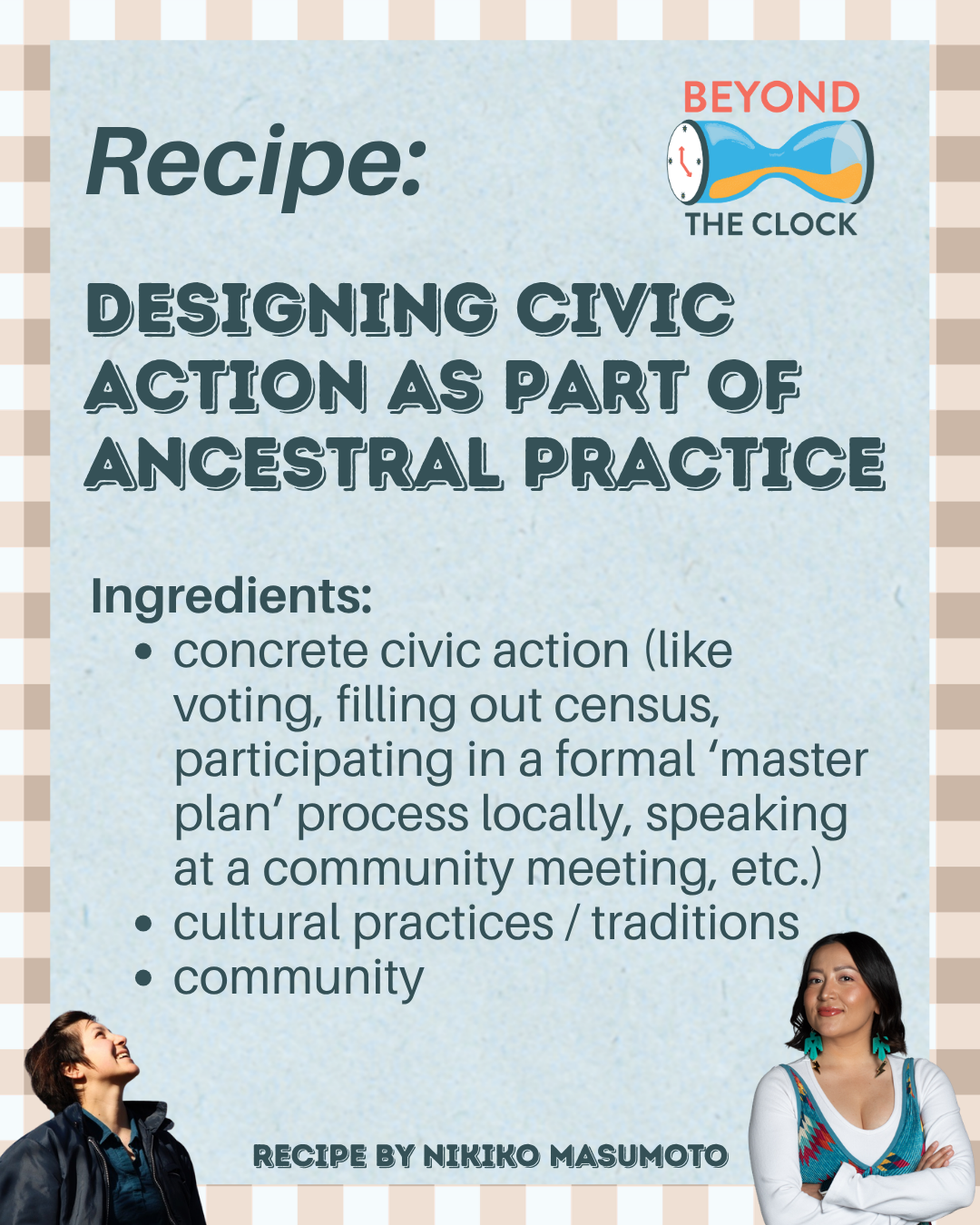
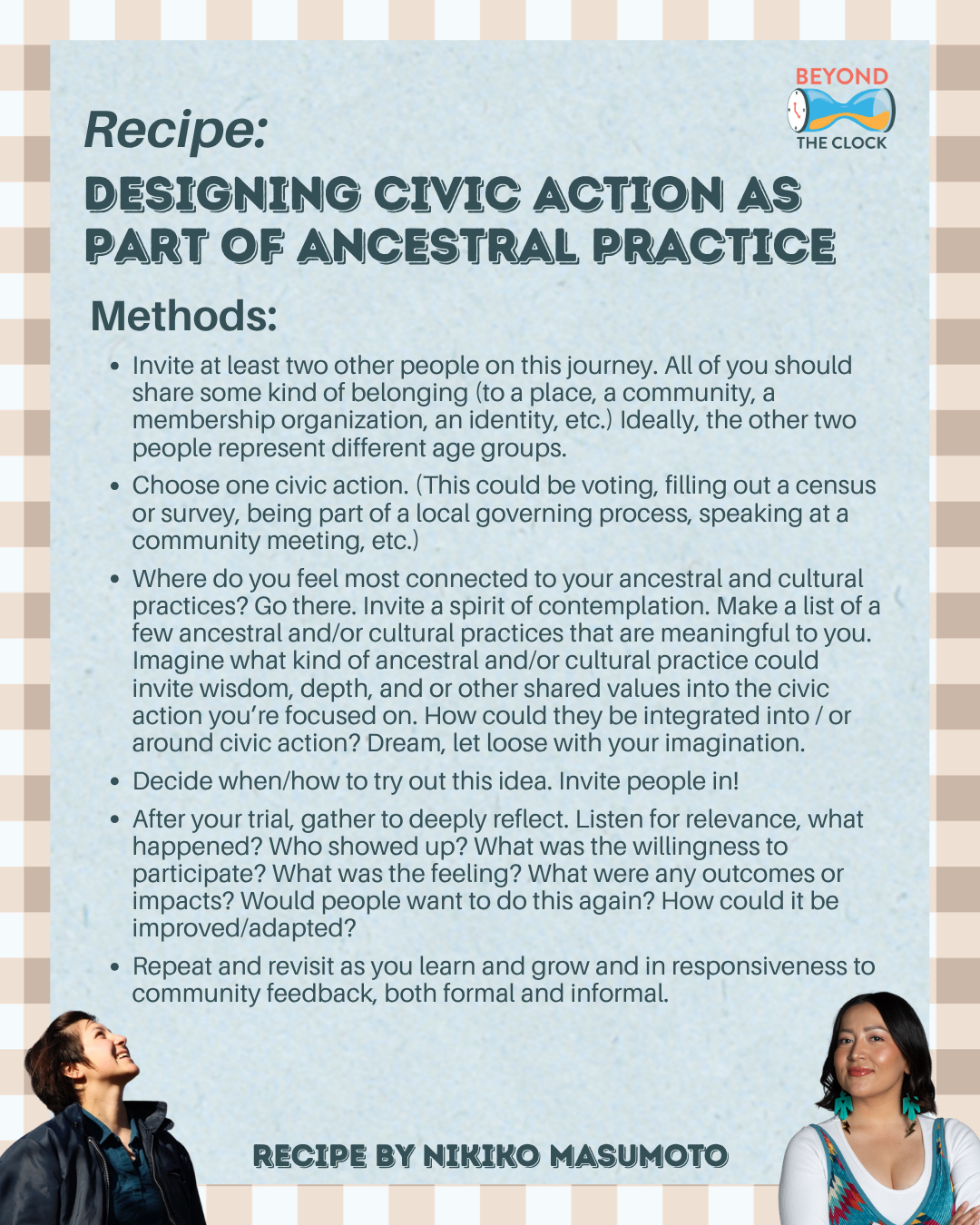
What a tremendous gift this episode is. What a tremendous gift Ms. Redhorse Young is. Inspired by this conversation, I’ve created a set of questions intended to bridge and open connection across generations. I’ve also created a ‘recipe’ (a recipe in this case is more of a guide or spark, open to adaptations) for reframing civic action within ancestral and cultural rituals.
Sparks (questions) for conversation across generations:
What makes you feel welcome?
What question do you wish people would ask you more often? (OR: What question do you wish people would stop asking you?)
Where and when do you feel most free?
What is your earliest memory?
Who is an ancestor you feel connected to?
Fill in the blank….when I think about the future,__________________.
What scent reminds you of home?
What are 2 places that you feel have shaped who you are?
What’s something you’ve inherited from an elder?
What’s something you hope to pass on to a younger person?
What season of life are you in? How does it feel?
How do you like to dress to express who you are?
When do you laugh the most?
About the 2026 Beyond the Clock Artist-in-Residence: Nikiko Masumoto
Nikiko Masumoto is an organic farmer and artist. She is Yonsei, fourth-generation Japanese American, and stewards the same soil her great-grandparents worked in California where Masumoto Family Farm grows organic fruit. She’s co-written several books, including most recently a children’s book, Every Peach is a Story, with her father David Mas Masumoto. Nikiko is an arts-leader and co-founder of Yonsei Memory Project, an arts-based initiative to activate Japanese American history in the Central Valley. She served on USDA’s State Committee, and volunteers on various non-profit boards. Her most cherished value is courage and most important practice is listening.