
Call for Rural Minnesota Community Teams!

2026-2027 Engage Rural Civic Arts Cohort

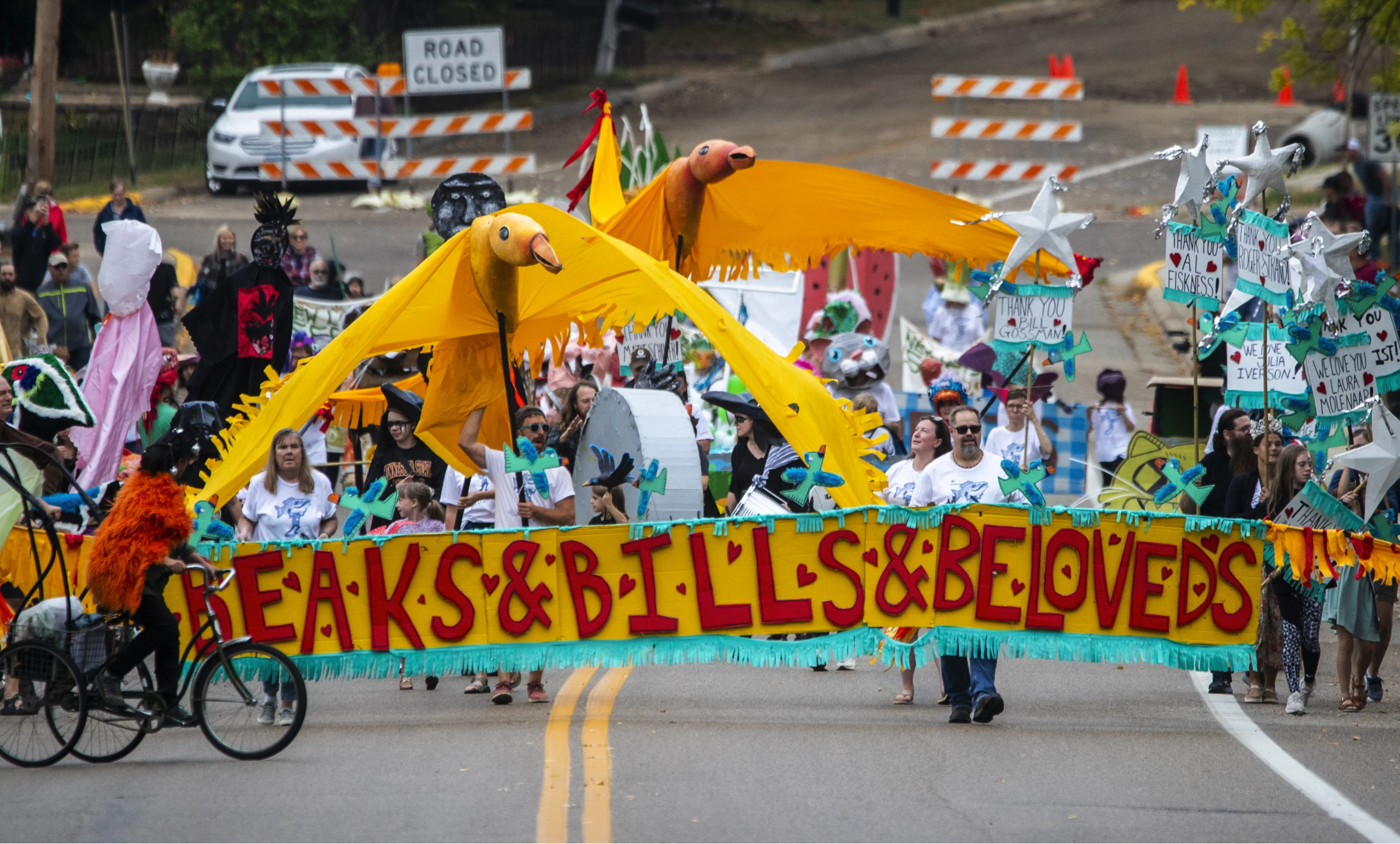
Department of Public Transformation has an open call for five rural Minnesota communities interested in developing creative strategies for civic engagement. Selected community teams will receive funding, curated technical assistance, and peer learning as a cohort for 12 months!


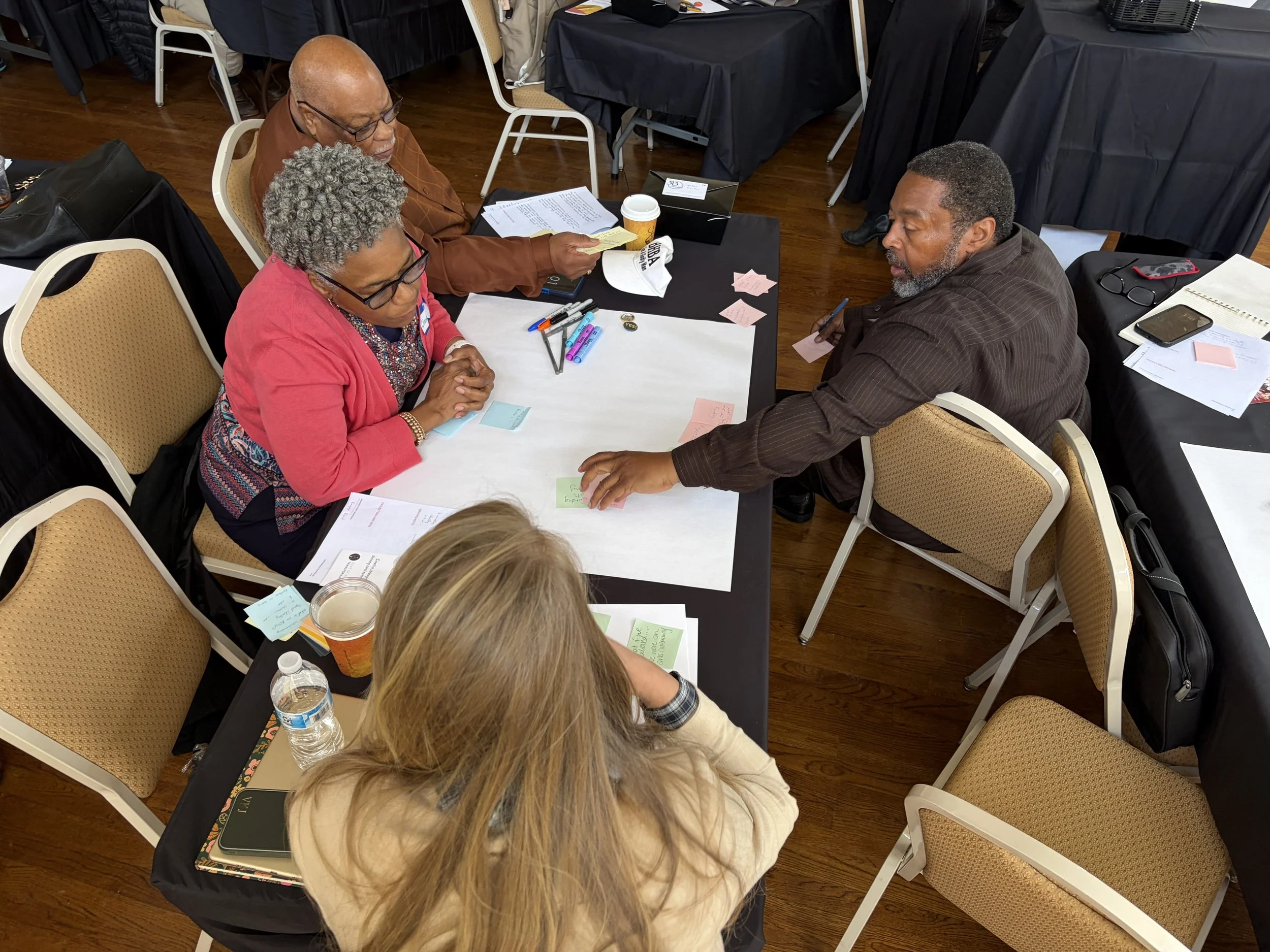
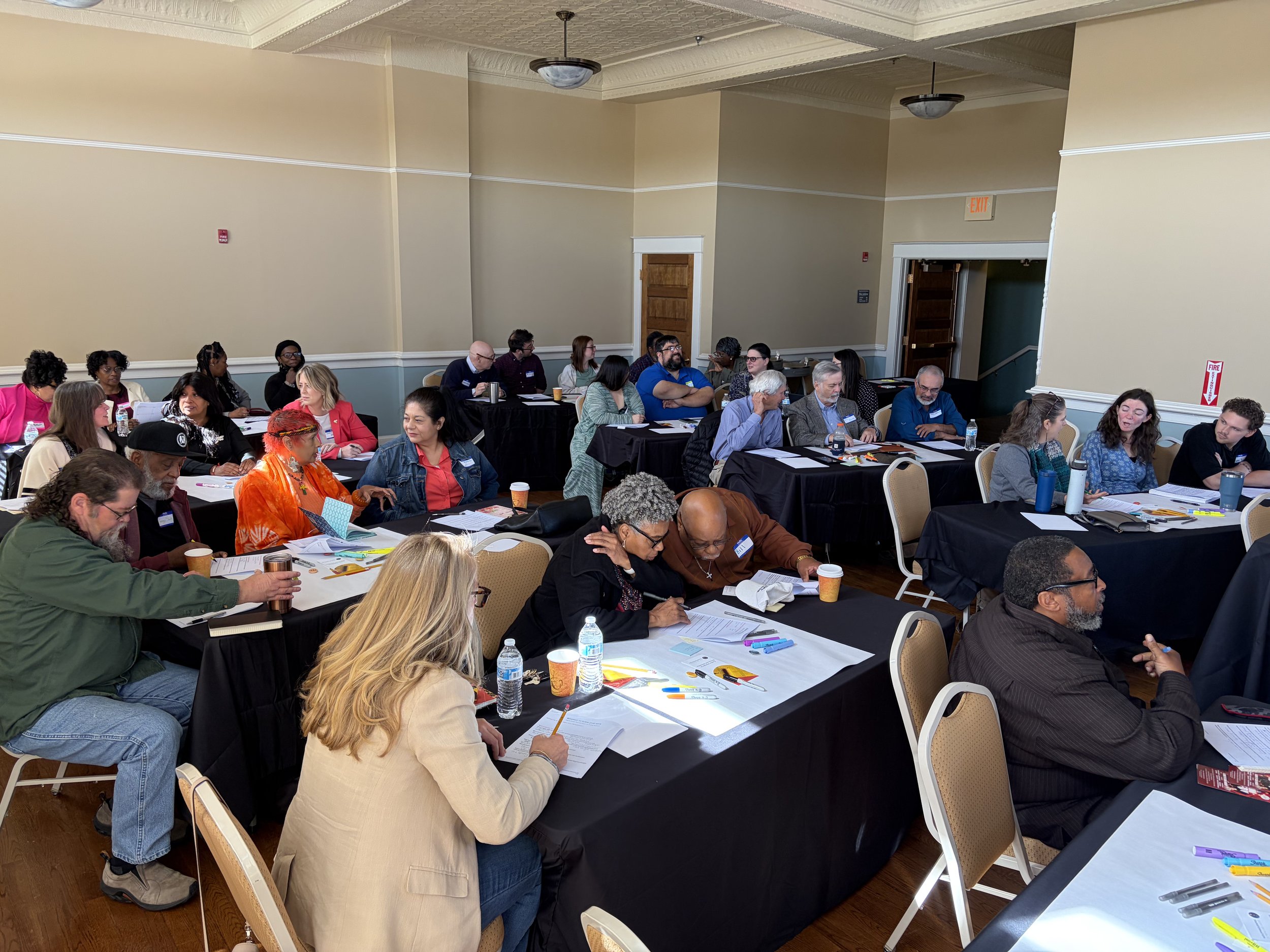
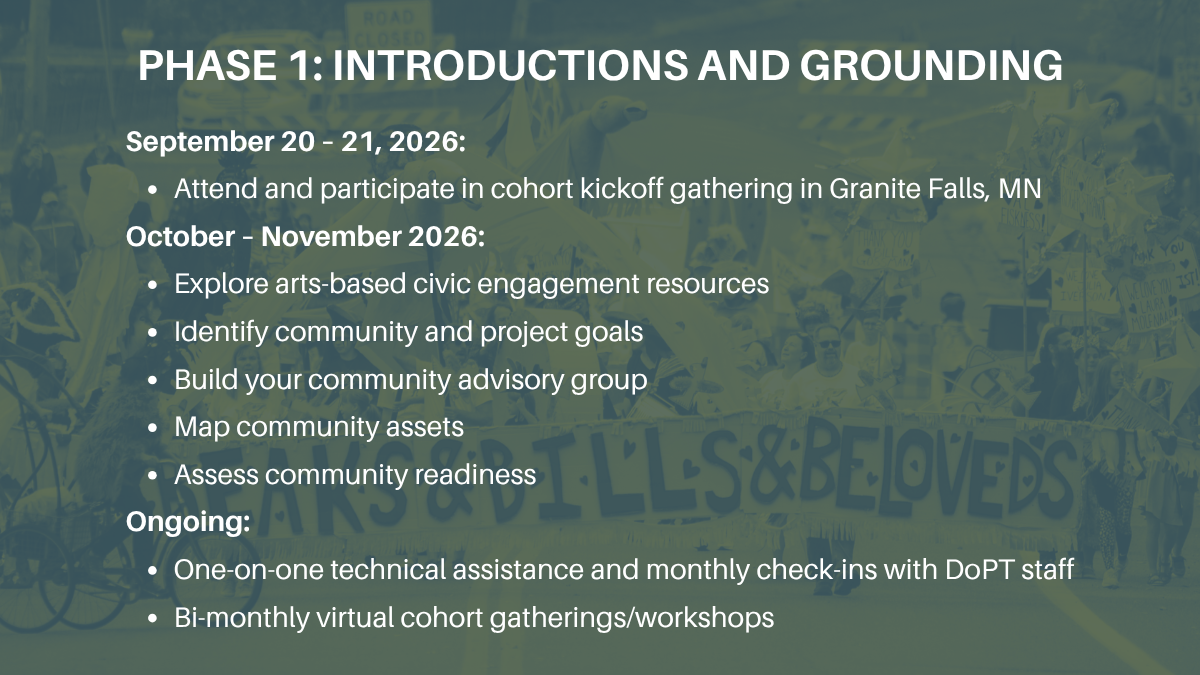
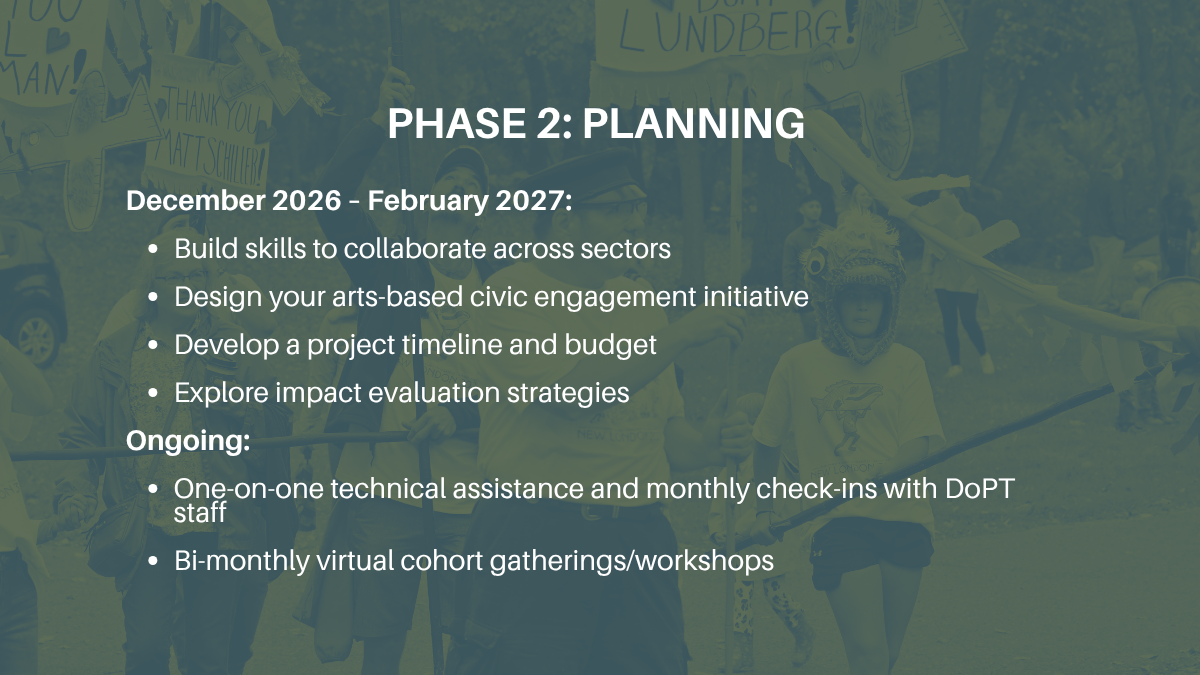
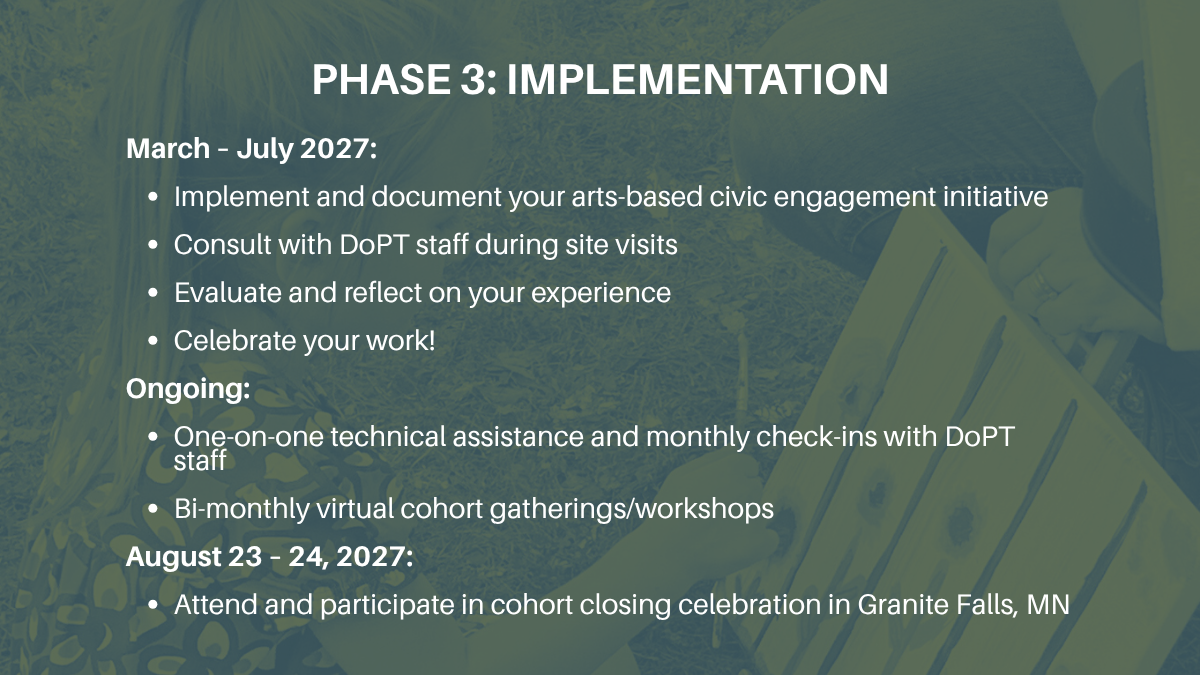
The Engage Rural Civic Arts Cohort is a year-long curated cohort experience for Core Teams based in rural Minnesota. Core Teams are made up of 3-5 rural community artists/cultural workers, community activators, and civic leaders. Selected Core Teams will spend twelve months developing creative strategies for civic engagement in their communities, with resources and guidance from DoPT staff. Project funding will support the implementation of those strategies, and cohort members will participate in project check-ins, exchange visits, workshops, and gatherings with fellow cohort members, featured guests, and DoPT staff. Program offerings will be adapted for the unique cultural, economic, and social needs of each participating community. This program is application-based, and participation will be at no cost to selected cohort members.

For the 2026-2027 cohort, DoPT will select 5 Core Teams who are based in rural communities with a population under 20,000 residents in Minnesota and the Native nations that share that geography.

Applications are due by June 17, 2026 at 11:59 pm CT


Selected Community Teams Will Receive:

  • $12,000 in project funding to design and implement a locally-defined arts-based civic engagement initiative

  • Site visits from DoPT staff to support project planning and local engagement; site visits will be scheduled in collaboration with each community and will be at no cost to the cohort members

  • Travel and lodging costs for 3 Core Team members to attend 2 in-person cohort gatherings, hosted at The YES! House in Granite Falls, Minnesota

  • Access to Engage Rural resources with strategies and recommendations for arts-based civic engagement

  • Curated technical assistance tailored to community goals, capacity, and context (monthly check-ins with the Engage Rural team and direct support with asset mapping and navigating community challenges and opportunities)

  • Supportive peer network (including bi-monthly virtual workshops and gatherings)

  • Project promotion and documentation support (video and storytelling)


Cohort Eligibility 

Eligible cohort communities are: 

  • Located in a rural community with a population of 20,000 or less in Minnesota or Native nations that share this geography

  • Invested in developing and implementing an arts-based civic engagement initiative

  • Led by a committed Core Team, which includes at least one arts and cultural worker, one civic leader (formal or informal), and one community activator. See FAQ for descriptions

  • The primary contact listed in the letter of agreement must be an entity with an EIN number and a bank account. These are the types of eligible entities because they are inherently community-driven:

    • Municipal, tribal, or county governments

    • Quasi-government entities like regional development commissions or regional arts councils

    • Local nonprofit organizations or fiscally sponsored groups, including, but not limited to Main Street or downtown organizations, art centers, preservation groups, historical societies, or community development organizations

    • Chambers of commerce

    • Cooperatives, including, but not limited to art collectives, restaurant or cafe, grocery

    • Public libraries

If you have a question about eligibility, please see the FAQ section and/or reach out to vivian@publictransformation.org prior to preparing an application. 

Cohort Selection Criteria

Selected cohort communities will meet the following criteria: 

  • Community Connection: There is an identified community challenge or opportunity that will be addressed through the arts-based civic engagement initiative; the Core Team has an understanding of and/or connection to their local community and the challenges and opportunities being addressed.

  • Capacity: There is an active Core Team meeting, planning, and working together. Core Team members commit to participating fully in Engage Rural Civic Arts Cohort activities between September 2026 and August 2027. Two to three team members are able to attend both Engage Rural Civic Arts Cohort in-person gatherings. At least one team member is able to serve as the primary contact to communicate and work regularly with DoPT staff.

  • Readiness: The team is ready to launch an arts-based civic engagement initiative within the Engage Rural Civic Arts Cohort 2026-2027 timeline. The application demonstrates enthusiasm for the process and openness to new ideas and approaches. Readiness is determined by: clear commitment from Core Team members, strong community relationships that can be identified by Core Team members, and concrete civic engagement challenges/opportunities that the Core Team and their community are hoping to explore through the Civic Arts Cohort experience.

  • Cohort and Project Diversity: The selection process will consider diversity of geographic locations, populations, civic engagement challenges/opportunities, and demographics. 

  • Applications are due by June 17, 2026 at 11:59 pm CT


COHORT EXPERIENCE


Cohort Selection Process 

A review committee of DoPT staff members and Minnesota rural civic arts leaders will consider applications based on project selection criteria. DoPT staff members will determine final selections.


Applications are due by June 17, 2026 at 11:59 pm CT


Informational Session: 2026 – 2027 Engage Rural Civic Arts Cohort

This virtual informational session provides an overview of the 2026 – 2027 Engage Rural Civic Arts Cohort and the application process.


This program is generously supported by the Blandin Foundation.


About Department of Public Transformation and Engage Rural

Department of Public Transformation (DoPT) believes that rural people and places have the answers they need to address challenges and opportunities. We champion art and artists as vital contributors to economic, community, civic, and social life, and we support rural communities in leveraging creative, cross-disciplinary, and asset-based approaches to build resilient rural futures.

DoPT’s Engage Rural program provides resources, guidance, and connection for rural community artists and leaders as they develop creative strategies for civic engagement. Such strategies can break down barriers to civic participation and strengthen local leadership.


Department of Public Transformation to Strengthen Civic Engagement in Rural Minnesota with $490,000 Blandin Foundation Grant

Grand Rapids, Minn. — April 27, 2026

Blandin Foundation has awarded a $490,000 grant over three years to Department of Public Transformation (DoPT) to support creative strategies that strengthen civic engagement, leadership and community connection in rural Minnesota.

The grant will expand the nonprofit’s Engage Rural program, which equips rural communities with creative and inclusive tools to broaden participation in civic life, build trust in local systems, and strengthen pride in place.

The Engage Rural program builds on lessons from a pilot project offered in 2022 with three southwest Minnesota communities. During the pilot, every $1 of an initial investment in creative civic engagement leveraged an average of at least $2.97 from other funding sources for creative community-engaged projects.


Frequently Asked Questions

Forest Color Block.png

Please note that the FAQs will continue to be updated throughout the application process as we receive questions from applicants. If you have additional questions, please contact the Engage Rural team:

Vivian M. Cook, Engage Rural Program Coordinator, vivian@publictransformation.org

  • Civic engagement is the active participation of individuals in the political, social, and cultural life of their community. It includes both formal activities like voting, attending town meetings, and advocacy, as well as informal actions like volunteering, community organizing, showing up at festivals and events, acts of neighboring, and creative expressions in public life. Civic engagement empowers people to work together to influence decisions that affect their daily lives, fostering a culture of collective responsibility and action. In rural communities, it often involves bridging gaps, building trust, and activating local assets and resources to address community needs.

  • Civic arts is an artistic practice that uses art and creativity to bring people together, spark conversations about local issues, and encourage more people to take part in community and civic life. Projects under the civic arts umbrella are created collaboratively, using art as a tool to address specific social, cultural, or environmental challenges within a community. Through community engagement—whether through workshops, public art installations, or collaborative performances—civic arts projects invite diverse voices, encourage collective action, and strengthen the fabric of rural communities. These kinds of creative projects give artists, civic leaders, and their communities new ways to improve civic health.

  • Check out our Engage Rural: Discover track resources to learn more about arts-based civic engagement!

  • Eligible cohort communities will be led by a Core Team. This team is a group of 3-5 community members from different sectors who are committed to facilitating creative collaboration and seeing the initiative through to the end.

    Eligible teams include at least one of each of the following:

    • Artist/Cultural Worker 

    • Civic Leader (Formal or Informal)

    • Community Activator

    Who is an Artist/Cultural Worker? 

    Artists/Cultural Workers are experienced in creative problem-solving and communication techniques. An artist is anyone who is creative, resourceful, inspired, and driven to collaborate across all sectors of public, private, and civic life. This includes mediums such as visual, performance, multimedia, literary, social/civic, culinary, land, traditional, folk, textile, events, and more. We mean culture bearers, craftspeople, artisans, hobbyists, contractors, and handypeople. An artist/cultural worker on your Core Team could be an artist themselves or someone who works directly with artists.

    Who is a Civic Leader? 

    Civic Leaders are familiar with the systems that impact and are impacted by the civic issue(s) explored in an arts-based civic engagement effort. Civic leaders include anyone who has taken on a leadership role in civic life—elected, staffed, volunteer, informal, or formal. Anyone who has the ability to influence change at a community-wide level is a civic leader. This could be community organizers, local government officials, tribal council, nonprofit leaders, city staff, faith leaders, youth organizers, influential neighbors, aunties and grandmas, elders, and more.

    Who is a Community Activator? 

    Community Activators are informed about the civic issue(s) that your specific artist-based civic engagement effort is hoping to explore, and they are invested in community-based solutions. A Community Activator is anyone who is an instigator, organizer, connector, and cheerleader of this specific effort. They are the ones ready to show up first, roll up their sleeves, and encourage others to join the journey. They are actively involved in community life and the specific civic issue(s) that have inspired the project, so they help to represent the broader community (in addition to an Advisory Group).

    Please review the resource, “Purpose and Make-Up of a Core Team” for more information about how to form a Core Team, and please reach out to us with questions!

  • The Engage Rural Civic Arts Cohort is open to teams based in rural communities—including tribal communities and Native Nations—with a population of 20,000 or fewer. 

  • The primary contact listed in the letter of agreement must be an entity with an EIN number and a bank account. These types of entities would be eligible because they are inherently community-driven:

    • Municipal, tribal, or county governments

    • Quasi-government entities like regional development commissions or regional arts councils

    • Local nonprofit organizations or fiscally sponsored groups, including, but not limited to Main Street or downtown organizations, art centers, preservation groups, historical societies, or community development organizations

    • Chambers of commerce

    • Cooperatives, including, but not limited to art collectives, restaurant or cafe, grocery

    • Public libraries

    Some entities that are NOT eligible to be the lead applicant include:

    • K-12 schools

    • Individual businesses or LLCs that do not have a community-driven team

    • Churches (programming cannot be affiliated with a religion)

    • Private Philanthropic Organization or Community Foundations


  • No. The Engage Rural team will work together with selected cohort teams to map out budgets based on the civic arts projects designed through the cohort experience. 


  • Team members will work with Ash Hanson, Creative Executive Officer, and Vivian M. Cook, Engage Rural Program Coordinator. Core team members can expect to periodically work with other DoPT staff members throughout the cohort experience. All staff bios are available at www.publictransformation.org/staff-board

  • Yes! If you are currently receiving support or if you have received support in the past through another DoPT program, you are still eligible to apply for the Engage Rural Civic Arts Cohort. 

  • No, but your Core Team must include representation from the three areas described above: Arts and Culture, Civic Leadership, and Community Activators. 

  • No, your representative from civic leadership can be, but does not have to be, someone from city or tribal government. See our definition of Civic Leader for more information. And make sure, in your application, to describe the roles of each of your Core Team members. 

  • Strong applications will come from Core Teams who are based in rural Minnesota communities with populations of 20,000 or fewer. Applicants will need to clearly identify that your team has an understanding of and/or connection to the local community and has strong community relationships.

  • Core Team members need to be 18+, but we encourage youth to be involved in advisory groups and the community process! While school districts are not eligible as the lead entity for the application, schools or school districts can be partners.

  • There are no requirements for startup capital, and match funding is not needed for this opportunity. 

  • Both. Applicants must be able to name one community, with a population of 20,000 or less, that will be the focus of your team’s work through the Civic Arts Cohort experience. One of the selection criteria is also “Community Connection,” which means applicants must demonstrate that they are in relationship with the people who live and work in that place. We also understand that rural communities often work together in a region, so feel free to describe in your application how your primary community might collaborate with or act as a hub for surrounding rural communities.

  • Yes. We would recommend that you list 3-5 Core Team members who are committed to participating in the entirety of the twelve-month Civic Arts Cohort experience. This includes meeting regularly with each other, communicating with DoPT staff, joining monthly check-in calls and bi-monthly cohort gatherings, and for 2-3 Core Team members, attending the two in-person cohort gatherings in Granite Falls. Your Core Team also needs to include representation from each of the following: Arts & Culture, Civic Leadership, and Community Activators. If you have more than five individuals invested in this opportunity, that’s great, though we would recommend naming just 3-5 under “Core Team” in the application. We’d invite you to discuss the full scope of community engagement, including additional participants, under the “Community Relationships” section of the application. (Note that part of the Civic Arts Cohort process will include developing a larger community advisory group for your initiative!)

  • If your community’s population is ~20,000, you are eligible. We recognize that community populations shift regularly, and that ruralness can be hard to define. This opportunity is designed for communities with populations of 20,000 or less, and community size will be taken into consideration in the selection process. If your community is slightly more than 20,000 (give or take a hundred residents or so), we would recommend that you discuss that in your application – for instance, clarify if your community is a rural hub and/or if your community serves multiple small/rural communities.

  • You do not need to have a clearly defined project. Your application must clearly identify the challenges and opportunities your team is hoping to address through the Civic Arts Cohort experience, but you will develop your specific project throughout the process.  

  • The primary community, Core Team, and lead applicant/entity must be within Minnesota or the Native Nations that share that geography. We will work with selected communities to create a budget during the cohort experience and can discuss specifics of how funds can be used at that time. 

  • Yes. Townships and unincorporated communities are eligible to apply, as long as the population is 20,000 or less. 

  • We can answer questions via email, but to maintain a fair and equitable process, we won’t be taking calls or meetings about applications. 

  • We will be in touch with all applicants, but, due to limited capacity, we are not able to offer specific feedback to each applicant. However, we want you to know that your projects and places matter, and we will continue to cheer you on! There will also be another cohort and a community of practice opportunity in 2027. You will be added to the mailing list for these opportunities.

  • Eligible nonprofit organizations include 501(c)(3), 501(c)(4), and other nonprofit entities with an EIN and bank account. Cohort funds may not be used for partisan political activities, candidate campaigns, lobbying, or election-related advocacy.

  • We understand that this can be a real challenge. One first step we would recommend is to map the existing assets in your community. Even if it feels like there is a lack of resources and support, there are assets in every community that can serve as a foundation for this work. Once you’ve identified some of those people and resources, reach out to start building a relationship and go from there. Check out “Purpose and Make-Up of a Core Team” and “Mapping Arts and Culture Resources” in the Engage Rural Resource Hub for some guidance. A reminder that an Engage Rural Civic Arts Cohort application does not need to identify a specific project, but rather strong community relationships and clear challenges/opportunities that your team hopes to address through the experience.